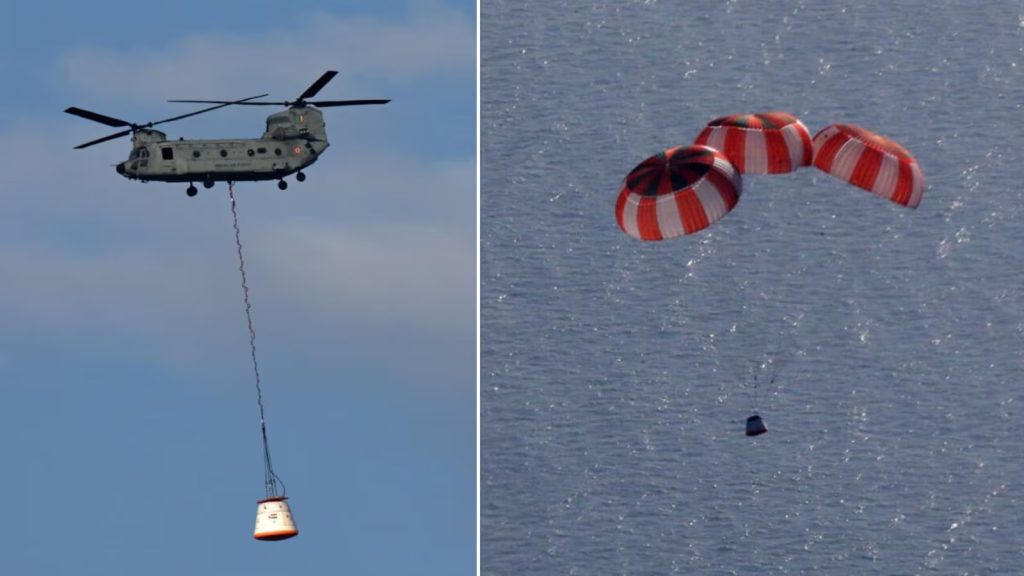
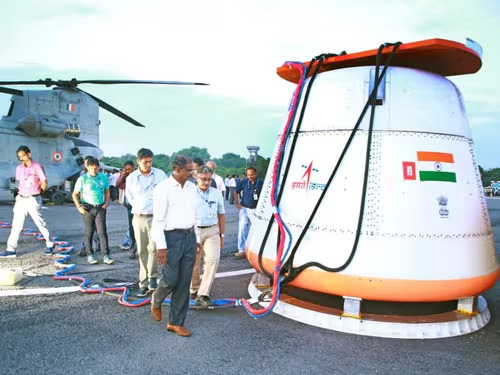
On 24 August 2025, the Indian Space Research Organisation (ISRO) completed its maiden Integrated Air Drop Test (IADT-01) for the parachute-based crew module deceleration system of the Gaganyaan mission. It was an important milestone in which ISRO successfully tested the entire sequence of parachutes to be deployed to guarantee the safe re-entry and splashdown of astronauts on future human spaceflight missions under the Gaganyaan mission.
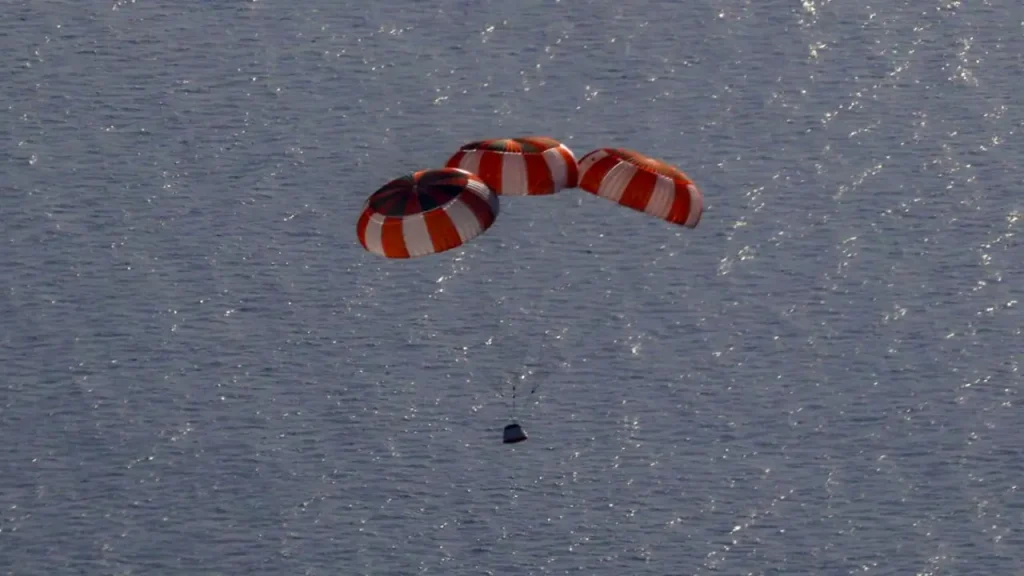
The test was conducted across the Bay of Bengal and entailed releasing a dummy payload of five tonnes, replicating the weight and configuration of the real crew module, from a military plane or helicopter. While previous tests have studied various elements of the parachute system—such as pilot, drogue, or main parachutes in isolation—this combined test sought to check how all components of the system interact when deployed under actual conditions. It encompassed the release of drogue chutes that initially stabilize and retard the module, followed by the pilot chutes and then the three main parachutes that lower the descent further and allow a safe splashdown.
The test witnessed successful coordination among various important Indian defense and space agencies. The ISRO also partnered with the Defence Research and Development Organisation (DRDO), Indian Air Force (IAF), Indian Navy, and Indian Coast Guard. These organizations all had crucial roles to play, ranging from controlling air deployment to tracking, recovery, and post-splashdown logistics. The Indian Navy was especially important in recovering the dummy module from the ocean, mimicking actual recovery scenarios that would occur on a crewed return mission.
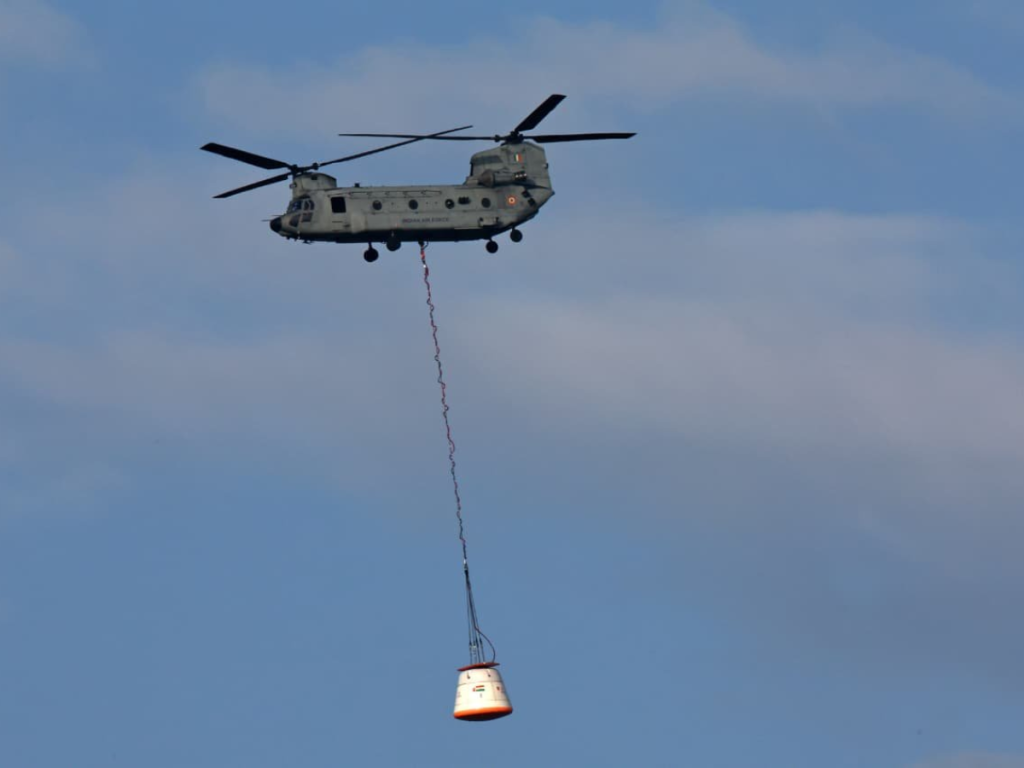
This success comes after years of subsystem testing. Specifically, ISRO had previously carried out several series of trials of individual parachute components, including a series of rail sled tests for drogue chutes and the Integrated Main Parachute Airdrop Test (IMAT) in November 2022. The 2022 test replicated a main chute failure case and assisted engineers with understanding failure modes and redundancies. But IADT-01 was the first time all the parachutes were tested in combination in a close-to-real environment, proving the logic of the full deceleration system coordination and deployment.
It is a success because it directly translates to the safety systems designed to safeguard astronauts during re-entry into the atmosphere, which is one of the riskiest parts of any spaceflight. The module needs to be decelerated from hypersonic velocities to a handful of meters per second at splashdown, and the parachute system is key to doing so safely. The outcome of this test reaffirms that the crucial mechanical sequencing, the aerodynamic control, and the terminal descent systems are all operating as per design.
ISRO now inches closer to its next key milestones with IADT-01 accomplished successfully. The following tests are the Pad Abort Test, where an emergency escape will be simulated from the launch pad to verify that astronauts will be safely jettisoned in the event of a critical failure in ascent. It will be followed by Test Vehicle Demonstration 2 (TV-D2), which will demonstrate abort capabilities at high altitudes. Subsequently in 2025, ISRO is scheduled to launch the maiden uncrewed orbital mission Gaganyaan-1, which will put a functional but empty crew module into low Earth orbit to validate its orbital performance, re-entry heat protection, and system integration in real space environment.
All of these are on a path to India’s first human spaceflight, which is scheduled to occur in 2027. The Gaganyaan crewed mission will transport Indian astronauts to space on board a human-rated version of ISRO’s GSLV Mk III rocket. Leading up to that, a series of unmanned missions, escape system tests, and full system simulations will need to be carried out.
Together, the achievement of IADT-01 marks a significant milestone not only for Gaganyaan but alsofor India’s overall aspirations in human spaceflight. It proves that ISRO is steadily working toward an objective that would position India as the fourth country in the world to send humans to space on its own.