New Delhi, India —
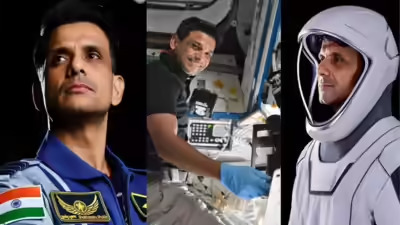
In a moment that will be remembered on the pages of Indian history, Wing Commander Subhanshu Shukla flew back to Earth after a fruitful ride into space, the second Indian to do so—and the first to do it as part of a wholly Indian command mission. His return was a strong landmark in the country’s path to space self-sufficiency and technological great-ness.
Subhanshu Shukla was on the Gaganyaan-II mission, India’s most ambitious human spaceflight mission so far. Launched from the Satish Dhawan Space Centre in Sriharikota, the mission put him in low Earth orbit, where he lived for seven days on the Gaganyaan crew module. Among the many experiments Shukla performed during his space flight were a series of microgravity, crew endurance, and spacecraft system studies—preparing the ground for future Indian missions to the Moon and further beyond. His presence on the module was symbolic of not only India’s technical competence but also its evolving status as an international player in space exploration.
The spacecraft entered Earth’s atmosphere and landed safely in the Arabian Sea as the Indian Navy and Indian Space Research Organisation (ISRO) teams carried out a smooth and rapid recovery operation. The cameras covered the momentous occasion as Shukla, still wearing his space suit, stepped out of the crew module with a steady wave and beaming smile. The photo of him thumbs-up to rescue workers has since been an iconic symbol of India’s scientific achievement.
On the ground, a ceremonial welcome was ready for him at an Indian Air Force facility. Prime Minister Narendra Modi, along with senior ISRO leaders, welcomed him personally, to pay tribute to the profound national pride his mission had triggered. In his short but powerful speech to the country, Shukla spoke of, “It was not my mission alone. It was India’s mission. I carried every Indian’s dream in me.” His words resonated with millions, particularly the young generation, who recognized in him not only an astronaut, but a representative of what contemporary India is all about—ambition, discipline, and innovation.
Subhanshu Shukla’s space journey is not just a testament to decades of scientific foundation built by Indian scientists and visionaries, but also a reminder of the nation’s ability to dream beyond limits. As opposed to Rakesh Sharma, India’s maiden astronaut who traveled on a Soviet spacecraft in 1984, Shukla’s flight was conceived, designed, and carried out completely by India. This fact signifies the progress of India’s space program from a dependent partner to an independent global player.

Nationwide, there were celebrations. There were special assemblies in schools, space fanatics at science museums, and social media streams full of messages of awe and pride. The nation came together in its tribute to the man who not just reached the stars but brought them a little closer to earth.
Subhanshu Shukla’s homecoming is not merely the conclusion of a mission—it is the first page of a new chapter for India in space exploration. When his feet touch soil again, his tale will inspire innumerable more to gaze up, dream big, and know that even the stars are in reach.