
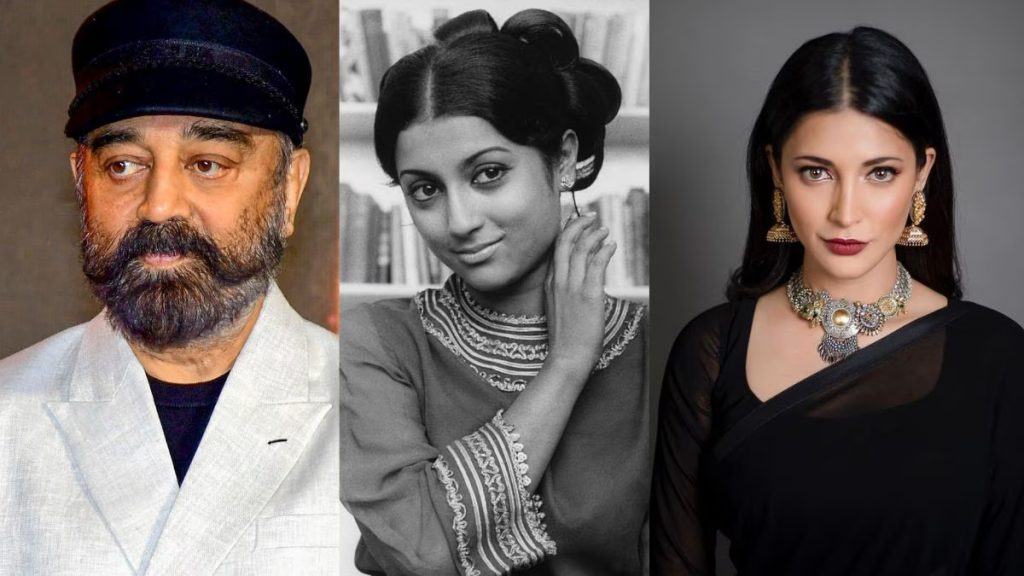
The anecdote of Kamal Haasan learning Bengali for Aparna Sen is a revealing and very human story that adds a splash of warmth and intrigue to the lives of two of Indian cinema’s most revered personalities. This lesser-known fact, not in the public domain for many years, was shared by Kamal Haasan’s daughter, Shruti Haasan, in a frank interview with actor Sathyaraj. While they were together, she talked about how much her father loved languages, culture, and people—something that Kamal Haasan fans have always envied. But what amazed many was the personal reason he chose to study Bengali.

withAs per Shruti, Kamal Haasan did not do Bengali due to a professional requirement or artistic necessity, which would have been entirely in line for someone as dedicated to his work. Rather, she told of how he picked up Bengali at a time when he was romantically attracted to Aparna Sen. As she put it, “he did not learn Bengali due to love for work, but because he was in love with Aparna Sen and to impress her, he learnt Bengali.” It was a quiet but powerful admission that revealed an unusual, emotional moment in the life of a man commonly respected for his intelligence and artistic gravity.
This anecdote is meaningful not merely because it illustrates Kamal Haasan’s much-reported love of education but also because it places that love in a human context—one that resonates with human vulnerability, desire, and the things people do to reach out across cultural divides for someone they respect. Aparna Sen, in her elegance, intelligence, and artistic taste, evidently made a lasting impact on Haasan, who was already known to be a connoisseur of culture, literature, and strong female characters—impersonalities that typified Aparna’s life and on-screen persona.

Their personal trajectories didn’t cross too often on film, and there is no documentation of a public romance between them. But Kamal Haasan’s gesture, if viewed in terms of admiration and implied love, highlights the sort of emotional and intellectual bonding he maybe aspired to achieve with her. It’s also not insignificant that Aparna Sen is a giant of Bengali cinema—an actress-director-writer whose films tend to address issues of identity, modernity, and female empowerment. That Kamal Haasan, himself a boundary-pusher of Indian cinema in all directions, would be attracted to her is natural and credible.
Adding to this story, Shruti Haasan further stated that her father also named the character of Aparna in his award-winning film Hey Ram after Aparna Sen. In this movie, Rani Mukerji acts as Bengali heroine Aparna Ram, Kamal Haasan’s wife. The name selection was seemingly not an accident. Shruti quietly divulged that it was a kind of tribute—a private nod buried in his piece, maybe an unpretentious gesture of appreciation to someone who was important at a critical juncture in his life. Considering that Hey Ram is a movie steeped in cultural and historical subtlety, the presence of a Bengali woman as a central emotional player in the story enriches that reading even more.
Kamal Haasan is reported to be fluent in multiple languages such as Tamil, Telugu, Hindi, English, Malayalam, and French. That he included Bengali in the list out of sheer personal motivation only lends to the aura of intellectual restlessness and emotional depth surrounding him. He is a person who has always confused the line between the personal and the creative. His passion films tend to bear the stamp of his personal life, beliefs, and relationships—philosophical, political, or emotional.
In some sense, this revelation by Shruti Haasan opens up to a larger consideration of how individual passions tend to shape the artistic paths of artists. Every public figure has inner desires and narratives behind them that may not feature in headlines or biographies, yet quietly influence the work they undertake and the legacies they leave. Kamal Haasan learning Bengali for Aparna Sen is not a sentimental yarn—it is a brief but instructive gesture that says a lot about admiration, how far one will go to be close to someone one admires, and the long-term bond between love and language.